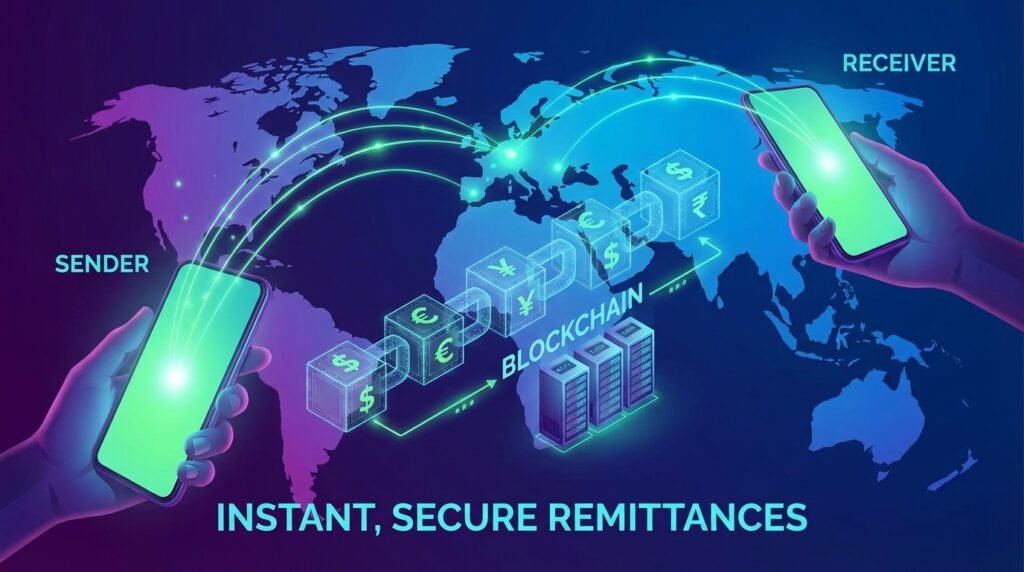
Instant secure remittances
A Clear Guide for 2026
Cross border money transfers have always been slow and expensive. Traditional remittance services depend on banks, clearing systems, and middlemen who handle the movement of money through multiple layers. This results in delays, high fees, currency conversion losses, and limited access for people in developing countries.
Blockchain technology offers a new way to send money across borders. Instead of relying on banks or centralized intermediaries, blockchain allows value to move directly between people in different countries. This is transforming global remittances and giving millions of people faster, cheaper, and more reliable payment options.
What Is Blockchain in Simple Terms
Blockchain is a digital ledger that records transactions across many computers at the same time. No single company controls it, and every transaction is secure, transparent, and time stamped.
For remittances, this means:
Direct transfers
Lower fees
Faster settlement
Greater transparency
Reduced fraud risks
How Blockchain Improves Remittances
Faster Transfers
Traditional international transfers can take several days because banks send funds through multiple layers.
Blockchain transactions can settle within minutes, even across long distances.
Lower Costs
Remittance companies typically charge high fees. Blockchain removes intermediaries, which reduces costs for the sender and receiver.
Greater Access
Anyone with a smartphone and internet connection can send or receive money, even without a bank account.
Transparency
Every transaction is recorded on a public ledger. This reduces disputes and makes it easier to track transfers.
Safety and Security
Blockchain uses cryptographic verification. This makes it difficult for hackers or fraudsters to manipulate transactions.
How Blockchain Remittances Work
The process is simple:
- The sender purchases a digital asset such as a stablecoin.
- The sender transfers the asset directly to the receiver’s wallet.
- The receiver keeps the digital asset or converts it into local currency.
Some companies convert blockchain based value into local currency instantly, so the receiver never needs to handle crypto.
The Role of Stablecoins in Remittances
Stablecoins such as USDT and USDC are widely used for blockchain remittances because they maintain a steady value.
They provide a simple way to send dollar equivalent value across borders without relying on traditional banks.
Stablecoins are especially popular in regions with limited access to US dollars or unstable local currencies.
Real World Uses of Blockchain Remittances
Freelancers and remote workers receiving international payments
Families sending money home from the diaspora
Small businesses paying overseas suppliers
Migrant workers supporting relatives
E commerce sellers receiving global payments
In each case, blockchain reduces friction and shortens the time it takes for money to arrive.
Companies Using Blockchain for Remittances
A growing number of financial technology companies use blockchain to power cross border payments.
These include global remittance providers, crypto exchanges, and mobile money platforms that support stablecoin settlements.
Many countries in Africa, Asia, and Latin America are seeing the fastest adoption because these regions experience high fees and slow processing times in traditional systems.
Challenges to Consider
Blockchain remittances are not perfect. Users should be aware of:
Regulatory uncertainty
Network congestion on some blockchains
Volatility of non stable crypto assets
Technical learning curve for new users
However, most challenges can be reduced by using reputable platforms, simple wallets, and well known stablecoins.
The Future of Remittances
Blockchain has reshaped cross border payments by offering speed, affordability, and global accessibility.
As more companies integrate blockchain technology, remittances are becoming more efficient and more inclusive.
In 2026 and beyond, blockchain based money transfers are expected to grow rapidly as more users embrace digital wallets, stablecoins, and online financial tools.